Study Guide
Sample Open-Response Item Assignments
This section of the study guide contains:
- Sample test directions for the open-response item assignments
- Two sample open-response item assignments
- Examples of strong responses to the assignments
- The performance characteristics and scoring scale
Sample Test Directions for Open-Response Item Assignments
This section of the test consists of two open-response item assignments. You will be asked to prepare a written response of approximately 150–300 words for each assignment. You should use your time to plan, write, review, and edit your response for each assignment. You must write responses to both of the assignments.
For each assignment, read the topic and directions carefully before you begin to work. Think about how you will organize your response. You may use the booklet of yellow erasable sheets to make notes, write an outline, or otherwise prepare your response. However, your score will be based solely on the version of your response that is typed in the on-screen response box.
Please note that symbols for long and short vowels are not available on the keyboard. A variety of symbols are available for insertion in the on-screen response box. To access these symbols, click on the
icon that appears in the upper left corner of the screen. Using the mouse, click on the symbol you wish to include in your response and then select "Insert". The symbol will be inserted where the cursor is positioned in the response box.
As a whole, your response to each assignment must demonstrate an understanding of the knowledge of the field. In your response to each assignment, you are expected to demonstrate the depth of your understanding of the subject area by applying your knowledge rather than by merely reciting factual information.
Your response to each assignment will be evaluated based on the following criteria.
- PURPOSE: the extent to which the response achieves the purpose of the assignment
- SUBJECT KNOWLEDGE: appropriateness and accuracy in the application of subject knowledge
- SUPPORT: quality and relevance of supporting evidence
- RATIONALE: soundness of argument and degree of understanding of the subject area
The open-response item assignments are intended to assess subject knowledge. Your responses must be communicated clearly enough to permit valid judgment of the evaluation criteria by scorers. Your responses should be written for an audience of educators in this field. The final version of each response should conform to the conventions of edited American English. Your responses should be your original work, written in your own words, and not copied or paraphrased from some other work.
Be sure to write about the assigned topics. You may not use any reference materials during the test. Remember to review your work and make any changes you think will improve your responses.
Sample Open-Response Item 1
Objective 0010
Prepare an organized, developed analysis on a topic related to the development of foundational reading skills.
Assignment
Use the information in each Exhibit to complete the assignment below.
Using your knowledge of foundational reading skills (e.g., phonemic awareness, phonics, recognition of high-frequency words, syllabication, morphemic analysis, automaticity, reading fluency [i.e., accuracy, rate, and prosody], self-correcting), write a response of approximately 150 to 300 words in which you:
- identify one significant strength that Jayden demonstrates related to foundational reading skills;
- identify one significant need that Jayden demonstrates related to foundational reading skills;
- based on the need you identified, describe an appropriate instructional strategy, activity, or intervention to use with Jayden; and
- explain why the instructional strategy, activity, or intervention you described would be effective for Jayden.
Be sure to cite specific evidence from the information provided to support all parts of your response.
Exhibit
Teacher Record
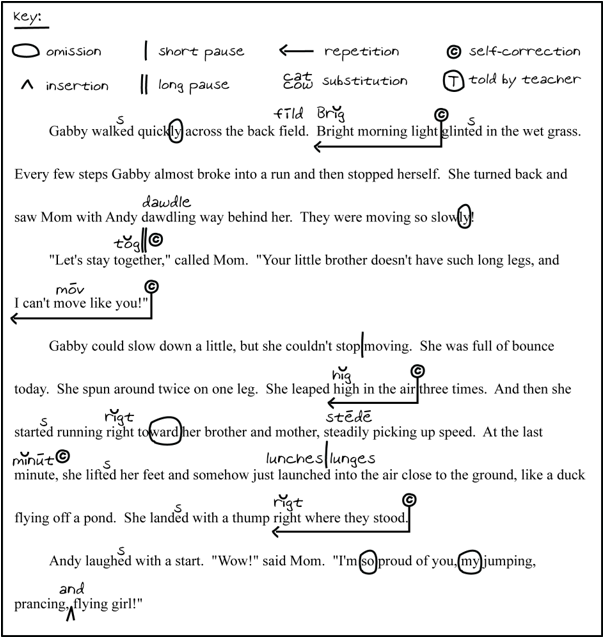
Early in the school year, Jayden, a third-grade student, reads aloud a passage from an unfamiliar narrative text. As Jayden reads, the teacher notes his performance on a separate copy of the text. Below is the teacher's record of Jayden's oral reading performance.
The passage has been marked by the teacher to indicate how the student read the text. There is a key to the symbols at the top of the passage. I will read the key first. Then I will read the passage through as it is written. I will then reread the passage a second time, indicating Jayden's performance and the teacher's observations."
Beginning of Key.
A circle around a word or letters indicates omission.
A single vertical line indicates a short pause.
Two vertical lines indicate a long pause
A back arrow indicates a repetition.
A circled letter C indicates a self-correction.
A carat indicates an insertion.
A word written above another word indicates a substitution.
A letter T with a circle around it indicates told by teacher.
End of key.
Beginning of passage.
Gabby walked quickly across the back field. Bright morning light glinted in the wet grass. Every few steps Gabby almost broke into a run and then stopped herself. She turned back and saw Mom with Andy dawdling way behind her. They were moving so slowly!
"Let's stay together," called Mom. "Your little brother doesn't have such long legs, and I can't move like you!"
Gabby could slow down a little, but she couldn't stop moving. She was full of bounce today. She spun around twice on one leg. She leaped high in the air three times. And then she started running right toward her brother and mother, steadily picking up speed. At the last minute, she lifted her feet and somehow just launched into the air close to the ground, like a duck flying off a pond. She landed with a thump right where they stood.
Andy laughed with a start. "Wow!" said Mom. "I'm so proud of you, my jumping, prancing, flying, girl!"
I will now read the passage again with the teacher's observations.
Gabby walked quickly across the back field. The teacher wrote S above the E D in the word walked and drew an omission circle around the L Y in quickly. Above the word field the teacher wrote F I L D with a macron above the I.
Bright morning light glinted in the wet grass. The teacher wrote B R I G with a breve above the I. The teacher marked a short pause before glinted, a self-correction symbol after light, and a repetition of the phrase bright morning light. The teacher wrote S above the E D in the word glinted.
Every few steps Gabby almost broke into a run and then stopped herself. The teacher did not mark this sentence.
She turned back and saw Mom with Andy dawdling way behind her. The teacher wrote D A W D L E above the word dawdling.
They were moving so slowly! The teacher circled the L Y in slowly.
"Let's stay together," called Mom. The teacher wrote T O G with a breve over the O above the word together. The teacher marked a long pause and self-correction symbol after T O G.
"Your little brother doesn't have such long legs, and I can't move like you!" The teacher wrote M O V with a macron over the O above the word move. The teacher marked a short pause after the word you and a repetition with self-correction symbol on the phrase I can't move like you.
Gabby could slow down a little, but she couldn't stop moving. The teacher marked a short pause before moving.
She was full of bounce today. The teacher did not mark this sentence.
She spun around twice on one leg. The teacher did not mark this sentence.
She leaped high in the air three times. Above the word high the teacher wrote H I G with a breve over the I. The teacher marked a short pause after the word air and a repetition with self-correction symbol on the phrase high in the air.
And then she started running right toward her brother and mother, steadily picking up speed. The teacher wrote S above the E D in the word started and R I G T with a breve above the I above the word right. The teacher circled W A R D in toward. The teacher wrote S T E D E with a macron above each E in the word steadily.
At the last minute, she lifted her feet and somehow just launched into the air close to the ground, like a duck flying off a pond. Above the word minute the teacher wrote M I N U T with a breve above the I and a macron above the U followed by a self-correction symbol. The teacher wrote S above the word lifted. Above the word launched the teacher wrote lunches, marked a short pause, and wrote lunges.
She landed with a thump right where they stood. The teacher wrote S above the E D in the word landed. The teacher wrote R I G T with a breve over the I above the word right. The teacher marked a short pause after the word stood and a repetition with self-correction symbol on the phrase right where they stood.
Andy laughed with a start. The teacher wrote S above the E D in the word laughed.
"Wow!" said Mom. The teacher did not mark this sentence.
"I'm so proud of you, my jumping, prancing, flying girl!" The teacher circled the words so and my. Between the words prancing and flying the teacher inserted a carat and the word and.
Exhibit
Oral Fluency Reading Rubric
Afterward, the teacher calculates Jayden's oral reading fluency (words correct per minute) and accuracy scores. The teacher also assigns Jayden a holistic score of 1 to 4 in three dimensions of his oral reading performance, with 4 representing the highest score for that dimension. These additional notes are shown below.
Indicator Score Words correct per minute 75 wcpm Accuracy 89% Pace 4 Prosody intentionally left blank Smoothness 3 Phrasing 4 Notes
Third–grade fiftieth percentile fall benchmark is 83 wcpm.
Sample Strong Response to Open-Response Item 1
The sample response below reflects a strong knowledge and understanding of the subject matter.
Jayden demonstrates significant strength in many basic decoding skills, including reading high-frequency words with automaticity and reading words with beginning and final consonant blends (ground), compound words (herself), contractions (doesn't), and basic vowel teams such as E A (leaped), A Y (stay), and the diphthong A W (saw). These decoding skills contributed to Jayden's strengths in the fluency areas of pace (speed) and phrasing.
Jayden demonstrates a significant need in reading accuracy (89% is very low), particularly decoding words with advanced vowel teams. He had difficulty decoding E A pronounced with short e (reading steadily as "steedee"), I E pronounced with long e (reading field as filed), and I G H , pronouncing it with a short i instead of long i (reading bright as brig, high as hig, right as rigt). Jayden also frequently misreads words with inflectional ( E D ) and derivational ( L Y ) affixes (substituting s for E D in several words and dropping L Y in quickly, slowly, and steadily). Jayden's low accuracy affected the number of words he's able to read correctly per minute (below 50th percentile), and would also affect reading comprehension.
An appropriate instructional strategy for teaching Jayden more advanced vowel teams would be to provide him with explicit instruction and guided practice reading and writing words containing a target vowel team (e.g., I G H ), both in isolation (e.g., reading aloud target word lists with immediate teacher feedback, conducting word sorts of words that represent different spellings of the same target sound) and in connected text (e.g., reading decodable texts and writing original poems that feature words with the target vowel team).
This instructional strategy would be effective for Jayden because it would promote his accurate, automatic recognition of words that contain the target vowel team. More accurate word reading would improve Jayden's reading fluency rate (words correct per minute) and support his reading comprehension.
Sample Open-Response Item 2
Objective 0011
Prepare an organized, developed analysis on a topic related to the development of reading comprehension.
Assignment
Use the information provided in the Exhibits to complete the assignment that follows.
Using your knowledge of reading comprehension (e.g., vocabulary knowledge; knowledge of academic language structures, including conventions of standard English grammar and usage; application of literal, inferential, or evaluative comprehension skills; use of comprehension strategies; application of text analysis skills to a literary or informational text, including determining key ideas and details, analyzing craft and structure, or integrating knowledge and ideas within a text or across texts), write a response of approximately 150 to 300 words in which you:
- identify one significant strength that James demonstrates related to one of the reading comprehension factors listed;
- identify one significant need that James demonstrates related to one of the reading comprehension factors listed;
- based on the need you identified, describe an appropriate instructional strategy, activity, or intervention to use with James; and
- explain why the instructional strategy, activity, or intervention you described would be effective for James.
Be sure to cite specific evidence from the information provided to support all parts of your response.
Exhibit
Reading Passage
As part of an informal reading comprehension assessment, James, a third-grade student, reads a passage from the children's novel The Mighty Miss Malone by Christopher Paul Curtis. The teacher explains that the story is about the experiences of a 12-year-old girl, Deza Malone, and her family. The teacher has James read from a passage in which Deza's brother, Jimmie, is singing the national anthem before a baseball game begins. James reads the passage aloud fluently and accurately, then the teacher gives him the opportunity to reread the passage silently. Following is the passage that James read.
When I'm writing or reading a book, everything else around me disappears. Father says it's because I've settled into what I'm doing, the same way my brother Jimmie does when he's singing.
Clarice hopped up and down, waving and yelling, "Jimmie! Yoo-hoo! Over here!"
I knew Jimmie couldn't hear her. He was settling into his song.
He cleared his throat, took three deep breaths, held the last one, then sang,
"Oh, say, can you see …"
I'm not sure what's more surprising about the first notes of any song Jimmie sings—what it does to me, or the changes it brings in Jimmie.
I have to close my eyes, just like he does. I can't tolerate anything that would interfere with hearing his voice.
Listening to Jimmie brings to mind how Father used to swing me around and around by my wrists until everything became a blur, and even though I knew he was holding me, I felt like if I didn't hang on as tight as I could I'd fly off into the sky like a arrow [sic].
And it seems like Jimmie makes himself larger and larger as he sings. If I opened my eyes I'd see he'd grown so much that he was filling every square inch of the park. No room would be able to hold him, chairs and rugs would get crowded up against the walls.
His voice always stayed light and high-pitched and soft, but it was strong in a way that let on that there were stories behind each word.
"By the dawn's early light …"
It felt like those words were asking you something and telling you something and blaming you for something, all at the same time.
"What so proudly we hailed
At the twilight's last gleaming …"
He finished the anthem,
"… And the home of the brave."
There was no sound from the baseball diamond or the bleachers or the people bunched around the picnic table. Then a explosion [sic] of cheers and a huge throwing-up of hands.
Exhibit
Student Response
After James finishes reading the passage silently, the teacher asks him some questions about what he has read. Below is a transcript of their conversation.
Teacher: What is this passage about?
James: It's about… I don't know. Not much happens, really. It's just, you know, the narrator saying what she's thinking.
Teacher: Interesting. What is the narrator thinking about?
James: It's kind of dreamy. Maybe it is a dream.
Teacher: What makes you say that?
James: She tells how she'll be doing something, like she's reading, and suddenly everything disappears.
Teacher: Mm, right—at the beginning. Take a look (pointing to the first paragraph). What is the narrator describing?
James: (looking over the passage) She's reading a book. Then she settles into it. Is she, like, settling into bed? And she starts dreaming?
Teacher: Hmm. What does she say about Jimmie in here? How are they alike?
James: They both have the dreaming thing, where everything disappears.
Teacher: Tell me, what is the main idea the narrator wants the reader to understand in this passage?
James: I don't know.
Teacher: Where does the passage take place?
James: Well, first the narrator is in bed reading, and then they go somewhere else.
Teacher: What's the main event in the passage?
James: Jimmie singing.
Teacher: Uh-huh. What does the narrator say about Jimmie's singing?
James: She needs to close her eyes to concentrate on it. Then she starts thinking about her dad swinging her around.
Teacher: Why does she think about that just when she's concentrating on Jimmie singing?
James: That's what I mean. It's like a dream the way the story flips around. She's reminded of her dad swinging her around and then he is swinging her around.
Teacher: What feeling is she describing?
James: She thinks she's going to fly off.
Teacher: When Jimmie is singing?
James: Yeah. She thinks … she dreams he's getting bigger and bigger like a giant, and he crowds stuff against the walls.
Teacher: How does the passage end?
James: Jimmie finishes singing, and there's an explosion, and the people start throwing stuff. Kind of weird! Maybe the explosion was just in her dream?
**Excerpt(s) from THE MIGHTY MISS MALONE by Christopher Paul Curtis, copyright © 2012 by Christopher Paul Curtis. Used by permission of Wendy Lamb Books, an imprint of Random House Children's Books, a division of Penguin Random House LLC. All rights reserved.**
Sample Strong Response to Open-Response Item 2
The sample response below reflects a strong knowledge and understanding of the subject matter.
James demonstrated a significant strength in understanding academic vocabulary. For example, his responses demonstrated understanding of several Tier Two words in the text (tolerate, interfere, explosion), and he accurately used the Tier Two words mentions, concentrate, and confused in his responses. In addition, he demonstrated understanding of basic Tier Three terminology (narrator, main idea, main event).
James demonstrated a significant need understanding figurative language. For example, he demonstrated literal understanding of the word explosion and the expression "a huge throwing-up of hands" (meaning applause) in his response, "Jimmie finishes singing and there's an explosion and the people start throwing stuff…." He also demonstrated literal understanding of the metaphor Deza uses (her father swinging her around) to describe her feelings when listening to Jimmie sing. James says, "It's like a dream the way the story flips around. She's reminded of her dad swinging her around and then he is swinging her around." James does not understand the metaphor that Jimmie's singing gives Deza a soaring feeling.
James would benefit from explicit teaching about figurative language. The lessons should include explanations and examples of types of figurative language (e.g., metaphors, similes) and how authors use them as part of their craft. The teacher should model how to distinguish literal from figurative language by using the context in a narrative to determine the meaning of specific words and phrases. The teacher should support James in interpreting examples of figurative language in various texts and have him practice developing metaphors and similes in his own narrative writing and poetry.
This strategy would be effective because learning to interpret figurative language would improve James's text analysis skills by supporting him in making inferences about the feelings and actions of characters in literary texts. Using figurative language in his own writing would reinforce his learning.
Performance Characteristics
The following characteristics guide the scoring of responses to the open-response item(s).
| Purpose | The extent to which the response achieves the purpose of the assignment. |
|---|---|
| Subject Matter Knowledge | Accuracy and appropriateness in the application of subject matter knowledge. |
| Support | Quality and relevance of supporting details. |
| Rationale | Soundness of argument and degree of understanding of the subject matter. |
Scoring Scale
The scoring scale below, which is related to the performance characteristics for the tests, is used by scorers in assigning scores to responses to the open-response items.
| Score Point | Score Point Description |
|---|---|
| 4 |
The "4" response reflects a thorough knowledge and understanding of the subject matter.
|
| 3 | The "3" response reflects an adequate knowledge and understanding of the subject matter.
|
| 2 | The "2" response reflects a limited knowledge and understanding of the subject matter.
|
| 1 | The "1" response reflects a weak knowledge and understanding of the subject matter.
|
| U | The response is unrelated to the assigned topic, illegible, primarily in a language other than English, not of sufficient length to score, or merely a repetition of the assignment. |
| B | There is no response to the assignment. |